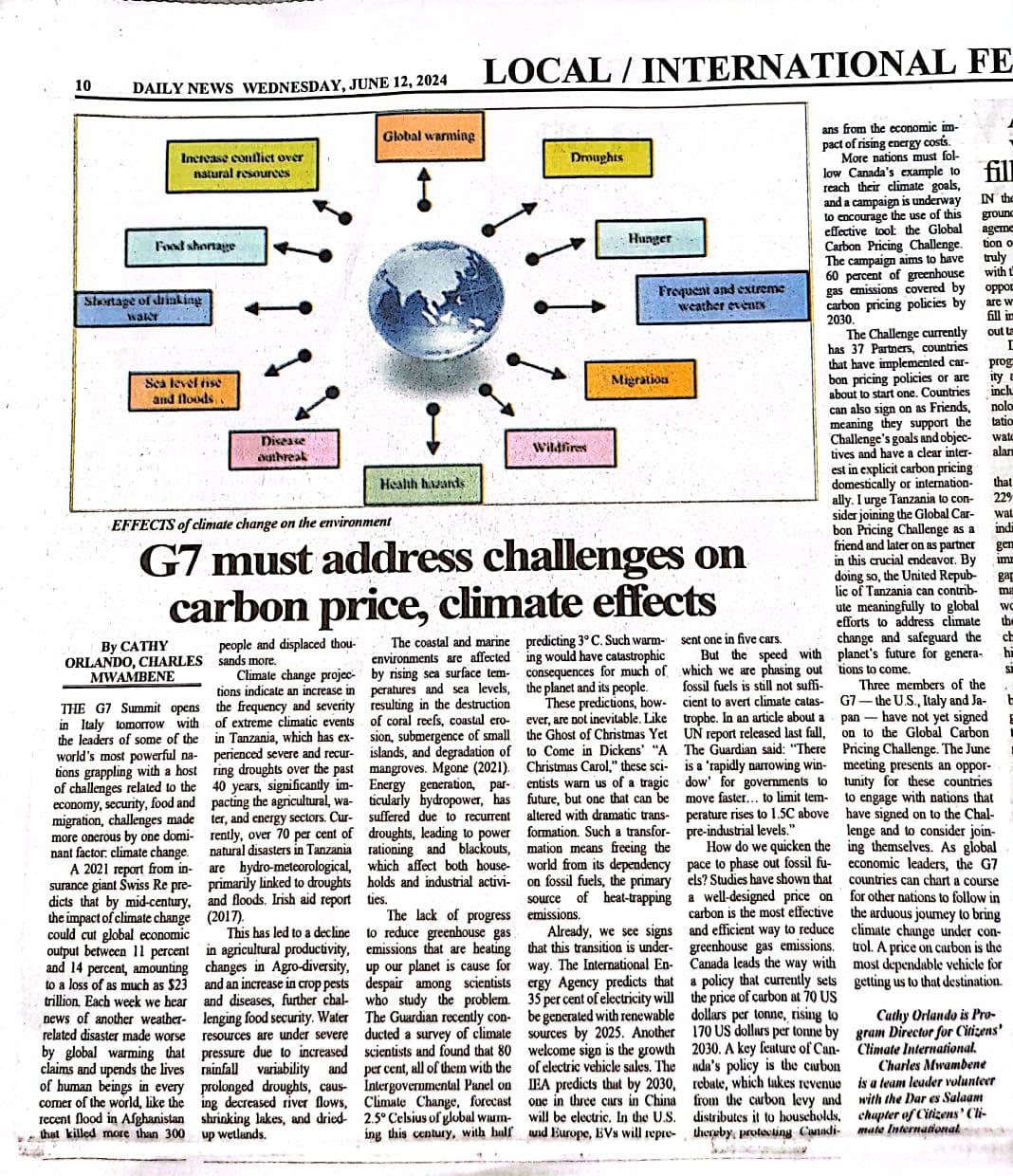
The G7 Summit opens in Italy on June 13 with the leaders of some of the world’s most powerful nations grappling with a host of challenges related to the economy, security, food and migration, challenges made more onerous by one dominant factor: climate change.
A 2021 report from insurance giant Swiss Re predicts that by mid-century, the impact of climate change could cut global economic output between 11 percent and 14 percent, amounting to a loss of as much as $23 trillion. Each week we hear news of another weather-related disaster made worse by global warming that claims and upends the lives of human beings in every corner of the world, like the recent flood in Afghanistan that killed more than 300 people and displaced thousands more.
Climate change projections indicate an increase in the frequency and severity of extreme climatic events in Tanzania, which has experienced severe and recurring droughts over the past 40 years, significantly impacting the agricultural, water, and energy sectors. Currently, over 70% of natural disasters in Tanzania are hydro-meteorological, primarily linked to droughts and floods. Irish aid report (2017). This has led to a decline in agricultural productivity, changes in Agro-diversity, and an increase in crop pests and diseases, further challenging food security. Water resources are under severe pressure due to increased rainfall variability and prolonged droughts, causing decreased river flows, shrinking lakes, and dried-up wetlands. The coastal and marine environments are affected by rising sea surface temperatures and sea levels, resulting in the destruction of coral reefs, coastal erosion, submergence of small islands, and degradation of mangroves. Mgone (2021). Energy generation, particularly hydropower, has suffered due to recurrent droughts, leading to power rationing and blackouts, which affect both households and industrial activities.
The lack of progress to reduce greenhouse gas emissions that are heating up our planet is cause for despair among scientists who study the problem. The Guardian recently conducted a survey of climate scientists and found that 80 percent, all of them with the Intergovernmental Panel on Climate Change, forecast 2.5° Celsius of global warming this century, with half predicting 3° C. Such warming would have catastrophic consequences for much of the planet and its people.
These predictions, however, are not inevitable. Like the Ghost of Christmas Yet to Come in Dickens’ “A Christmas Carol,” these scientists warn us of a tragic future, but one that can be altered with dramatic transformation. Such a transformation means freeing the world from its dependency on fossil fuels, the primary source of heat-trapping emissions.
Already, we see signs that this transition is underway. The International Energy Agency predicts that 35 percent of electricity will be generated with renewable sources by 2025. Another welcome sign is the growth of electric vehicle sales. The IEA predicts that by 2030, one in three cars in China will be electric. In the U.S. and Europe, EVs will represent one in five cars.
But the speed with which we are phasing out fossil fuels is still not sufficient to avert climate catastrophe. In an article about a UN report released last fall, The Guardian said: “There is a ‘rapidly narrowing window’ for governments to move faster… to limit temperature rises to 1.5C above pre-industrial levels.”
How do we quicken the pace to phase out fossil fuels? Studies have shown that a well-designed price on carbon is the most effective and efficient way to reduce greenhouse gas emissions. Canada leads the way with a policy that currently sets the price of carbon at $70 per tonne, rising to $170 per tonne by 2030. A key feature of Canada’s policy is the carbon rebate, which takes revenue from the carbon levy and distributes it to households, thereby protecting Canadians from the economic impact of rising energy costs.
More nations must follow Canada’s example to reach their climate goals, and a campaign is underway to encourage the use of this effective tool: the Global Carbon Pricing Challenge. The campaign aims to have 60 percent of greenhouse gas emissions covered by carbon pricing policies by 2030.
The Challenge currently has 37 Partners, countries that have implemented carbon pricing policies or are about to start one. Countries can also sign on as Friends, meaning they support the Challenge’s goals and objectives and have a clear interest in explicit carbon pricing domestically or internationally. I urge Tanzania to consider joining the Global Carbon Pricing Challenge as a friend and later on as partner in this crucial endeavor. By doing so, the United Republic of Tanzania can contribute meaningfully to global efforts to address climate change and safeguard the planet's future for generations to come.
Three members of the G7 — the U.S., Italy and Japan — have not yet signed on to the Global Carbon Pricing Challenge. The June meeting presents an opportunity for these countries to engage with nations that have signed on to the Challenge and to consider joining themselves. As global economic leaders, the G7 countries can chart a course for other nations to follow in the arduous journey to bring climate change under control. A price on carbon is the most dependable vehicle for getting us to that destination.
Cathy Orlando is the Director for Citizens’ Climate International.
Charles Mwambene is a team leader and volunteer with the Dar es salaam chapter of Citizens’ Climate International.